

How to Choose the Right UCaaS Platform for Your Business in 2026
The Complete Buyer’s Guide to Modern Business Communications
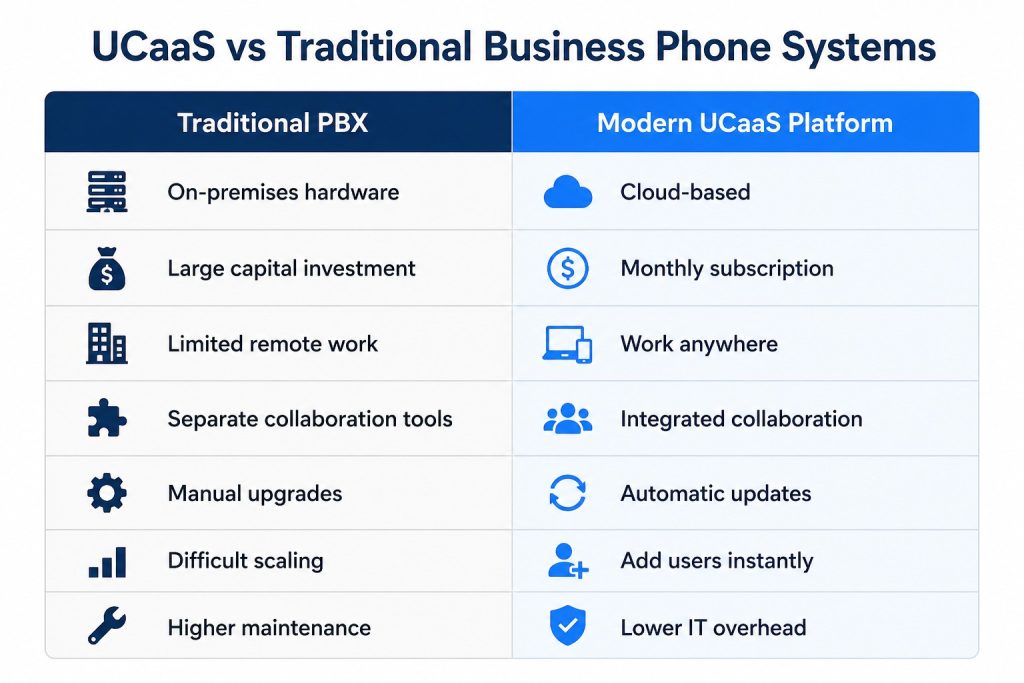
Businesses are rapidly replacing aging PBX systems, legacy phone lines, and analog infrastructure with unified communications as a service (UCaaS). Modern UCaaS platforms combine voice, video, messaging, collaboration, and mobility into a single cloud-based solution that helps organizations improve productivity while reducing the cost and complexity of managing communications.
Whether you’re replacing an aging Cisco, Avaya, Mitel, or NEC phone system—or planning to eliminate traditional POTS lines—selecting the right platform requires more than comparing monthly pricing.
This guide explains what to evaluate before choosing a provider and the features that matter most for SMBs and mid-sized organizations in 2026.
What Is a UCaaS Platform?
A UCaaS platform delivers business communications through the cloud instead of on-premises hardware.
Most modern platforms include:
- Business VoIP calling
- Video conferencing
- Team messaging
- Mobile and desktop applications
- Presence and availability
- Call routing and auto attendants
- Voicemail-to-email
- CRM integrations
- Microsoft Teams integration
- Analytics and reporting
Instead of managing multiple systems, organizations receive a single unified communications as a service platform that scales as the business grows.
Why Businesses Are Moving to UCaaS in 2026
Several technology shifts continue to accelerate cloud communications adoption.
Legacy phone systems are aging
Many organizations still rely on PBX systems that are expensive to maintain and increasingly difficult to support.
POTS lines are disappearing
Traditional analog telephone service continues to be phased out, requiring businesses to modernize services supporting:
- Fire alarms
- Elevators
- Security systems
- Fax machines
- Emergency phones
- Building access systems
A successful modernization strategy often combines a cloud-based UCaaS platform with managed POTS replacement solutions for analog devices that still require connectivity.
Hybrid work is now standard
Employees expect consistent communications regardless of location.
Modern business phone systems provide the same experience from:
- Office
- Home
- Mobile
- Branch locations
10 Questions to Ask Before Choosing a UCaaS Provider
1. Does the platform scale with your business?
Choose a solution that supports one office today and dozens tomorrow without replacing infrastructure.
2. What collaboration tools are included?
The best enterprise collaboration tools combine:
- Voice
- Video
- Messaging
- File sharing
- Presence
- Mobile apps
into one experience.
3. Does it integrate with your existing applications?
Look for integrations with:
- Microsoft Teams
- Microsoft 365
- Outlook
- Salesforce
- HubSpot
- CRM platforms
- Contact center software
Strong voice integration reduces manual work and improves customer experiences.
4. How easy is administration?
Managing users should take minutes—not hours.
Evaluate:
Self-service administration
Bulk user management
Device provisioning
Number management
Reporting dashboards
5. Can it support multiple locations?
Organizations with branch offices need centralized management.
The best SMB communication solutions simplify:
- Multi-site dialing
- Shared directories
- Auto attendants
- Centralized reporting
- Company-wide policies
6. How reliable is the provider?
Ask about:
- Uptime SLA
- Geographic redundancy
- Disaster recovery
- Network monitoring
- Business continuity
Communications should remain available even during local outages.
7. How does customer support work?
Technology matters.
Support matters more.
Look for:
- US-based support
- 24/7 availability
- Dedicated onboarding
- Porting assistance
- Ongoing account management
8. Does it support SIP trunking or BYOC?
Many organizations migrating from Cisco CUCM or other enterprise phone systems prefer flexibility when connecting carriers.
If SIP flexibility is important, verify supported deployment models before making a decision.
9. What security features are included?
Evaluate:
- Multi-factor authentication
- Encryption
- Role-based administration
- Compliance options
- Secure remote access
10. What is the total cost of ownership?
Monthly licensing tells only part of the story.
Include:
- Implementation
- Device replacement
- Porting
- Network upgrades
- Internet connectivity
- Ongoing administration
- Support
How UCaaS Fits Into a Complete Communications Strategy
UCaaS shouldn’t be evaluated in isolation.
Many organizations combine:
- UCaaS
- SD-WAN
- Managed Internet Connectivity
- Business Wireless Backup
- Managed Security
- Microsoft Teams Direct Routing
- Managed POTS Replacement
Together, these technologies create a resilient communications environment that supports today’s distributed workforce while improving reliability and reducing operational complexity.
Frequently Asked Questions
1. What is the difference between UCaaS and VoIP?
VoIP refers specifically to voice calling over the internet.
Unified communications as a service includes voice plus messaging, video meetings, collaboration, mobile applications, analytics, and integrations.
2. Are UCaaS platforms suitable for small businesses?
Yes. Modern UCaaS platforms scale from a handful of employees to thousands of users, making them ideal for growing SMBs and mid-market organizations.
3. Can UCaaS replace traditional POTS lines?
Not entirely. UCaaS replaces voice communications, but devices such as fire alarms, elevators, emergency phones, fax machines, and security systems often require dedicated managed POTS replacement solutions.
4. How important is Microsoft Teams integration?
For organizations already using Microsoft 365, Teams integration can simplify calling, collaboration, and user management while reducing the number of applications employees use each day.
Choosing the Right Partner Matters
Selecting a UCaaS platform is about more than features—it’s about finding a communications partner that can support your business as it grows.
At FirstComm, we help organizations modernize legacy phone systems, replace aging POTS infrastructure, and build reliable, secure communications environments with cloud voice, managed connectivity, Microsoft Teams solutions, and nationwide support. Whether you’re planning a new deployment or evaluating providers, our team can help design a solution that fits your business today and scales for tomorrow.
Ready to modernize your business communications? Contact FirstComm to speak with a communications specialist.